The Myth of the Artist’s Message as a Single Answer
The artist’s message is one clue, not a final verdict. Learn to weigh intention, form, context, and your own reading without flattening the work.
You leave a film, poem, or painting and hear someone ask, “What was the artist trying to say?” The artist’s message can be a useful starting point, but it is rarely a single answer that closes every other reading. A better approach is to separate what the maker says they intended from what the work lets you observe and what you make of it.
This does not mean that every interpretation fits. It means building a reading from evidence instead of treating either the artist’s comments or your first reaction as a verdict. Move through the work in order: notice, describe, consult context, compare, then state what remains uncertain.
Begin with what the work actually gives you
Before looking up an interview or reading a wall label, spend a little time with the work itself. Write down specific details: a repeated image, an abrupt change in tone, a figure turned away, a line that returns, or a sound that interrupts the pattern. Keep description separate from interpretation.
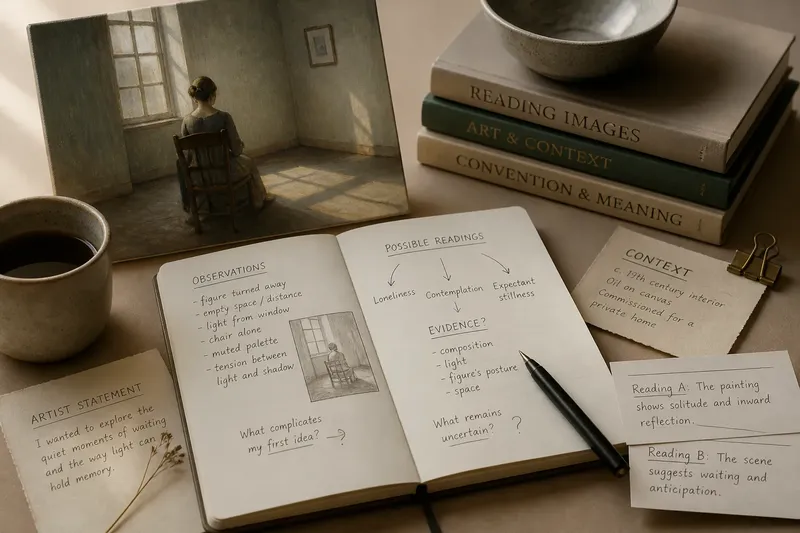
“A chair stands alone beneath a bright window” is an observation. “The chair represents loneliness” is a possible reading. The second may be persuasive, but it needs support. Ask what makes loneliness a reasonable inference: the empty space, the light, the composition, or a detail elsewhere in the work?
Notice the parts that complicate your first idea, too. A cheerful melody under a somber scene may unsettle a simple reading rather than confirm it. Record the tension instead of smoothing it away.
Start with details you can point to, not a theme you hope to find.
Separate stated intention from interpretation
An artist’s statement, interview, or note can tell you what the maker set out to do. It may explain a choice of materials, a personal point of departure, or the circumstances of a work’s creation. That information matters, but intention and result are not identical.
Ask what kind of claim the artist is making. “I wanted the repeated phrases to feel like a routine” describes an aim. “The work is about routine” offers a broader interpretation. Neither claim removes the need to look at how the work is built or how its details behave.
Then compare the statement with the work. Does the repetition feel routine, insistently comic, or increasingly uneasy? Does the stated intention account for the ending, image, or formal choice that caught your attention? An artist may clarify one part while leaving other features open.
Treat intention as evidence about the making, not a command about the meaning.
Use form as evidence, not decoration
Form is the way a work organizes its material: its structure, pacing, sound, color, point of view, scale, or arrangement. These choices shape what you can notice and when. They can support an interpretation even when the subject matter seems straightforward.
In a poem, short lines and broken syntax may make a speaker’s thought feel hesitant. In a song, a refrain that returns unchanged can sound comforting or trapped, depending on the surrounding verses and performance. In a painting, a figure placed at the edge may feel excluded, watchful, or simply positioned to balance the composition. The detail alone does not settle the question; its relation to the whole matters.
Say you read an invented short story in which a host keeps offering tea during an argument. You notice the repeated offer and the clipped dialogue, then interpret the tea as an attempt to restore politeness. If the final scene makes the host’s gestures feel controlling, revise your reading: the same detail may also show an effort to manage the room. The point is not to choose the cleverest symbol, but to explain how the form and scene support your claim.
Bring in context without letting it take over
Context can include the medium, the setting in which a work was made, its intended audience, or conventions the work draws on. A portrait made for a public institution, for instance, may use familiar signs of authority. Knowing that convention can sharpen your reading, but it does not tell you by itself whether the work endorses or questions that authority.
Look for context that answers a specific question raised by the work. If a material seems unusual, learn what it is and why its use might matter. If a narrative depends on a social custom you do not recognize, identify that custom before judging a character’s choices. Prefer reliable labels, catalogs, or artist statements over a loose association that merely sounds plausible.
Keep a boundary between what you know and what you infer. “The artist says this was made for a public ceremony” is a contextual fact if the source supports it. “The work therefore celebrates the institution” is an interpretation that still needs evidence in the work.
How can you test a reading without forcing one answer?
What counts as evidence for an interpretation?
Useful evidence is a feature you can locate and describe, such as a repeated phrase, a shift in perspective, or a contrast in color. Connect that feature to your claim and explain the connection, rather than offering the detail as if it speaks for itself.
Does the artist’s explanation settle the meaning?
It can clarify intention or circumstances, but it does not erase features the explanation leaves out. Compare the account with the work and be clear about where you agree, where it helps, and where it does not answer your question.
Can a work support more than one interpretation?
Yes, if each reading accounts for meaningful details and acknowledges evidence that complicates it. Two readings may focus on different elements without being equally convincing; coherence and attention to the whole help distinguish them.
What should you do when a detail remains unclear?
Leave it open, or describe more than one possibility. Uncertainty is more useful than inventing a hidden symbol when the work gives you no sound reason to choose one.
Compare readings, then state your own carefully
Once you have a provisional reading, test it against a plausible alternative. If you think a character’s silence signals shame, ask whether the same scene could suggest restraint or fear. Which details support each possibility? Does one explanation account for more of the work without ignoring the rest?
Imagine you are discussing an invented poster with a friend. You read its crowded lettering as a warning about noise; your friend sees a celebration of public life. Rather than voting for one answer, point to the type size, the scene, and the contrast between the text and image. You may find that the poster draws energy from crowds while also making them feel overwhelming.
When you share your conclusion, use language that shows its basis: “I read the ending as uneasy because the repeated phrase changes after the speaker leaves.” That sentence offers a reason and leaves room for another reader to respond. It is more useful than claiming to know exactly what the artist meant.
The artist’s message is one part of interpretation, alongside form, context, and the evidence available to a viewer. If you want a reliable reading, return to the work and ask which details carry your claim. That habit lets you make a clear argument without pretending that ambiguity is a mistake.